How to transport oversized cargo across the border in 2026: rules for Kazakhstan, Russia, China, and Central Asian countries
4 September 2026 г.
How to transport oversized cargo across the border in 2026: rules for Kazakhstan, Russia, China, and Central Asian countries
Prepared by NG-NEGABARIT's logistics team.
A single extra centimeter of width is enough to turn a routine delivery into a full permitting exercise, complete with escort vehicles and a bespoke route plan. Add a border crossing to the equation — Almaty to Novosibirsk, say, or China to Europe via the Khorgos crossing — and national permitting rules are joined by customs formalities and a distinct regulatory regime in every jurisdiction along the way.
Years spent moving equipment for industrial and mining clients across Kazakhstan, Russia, Central Asia and China have shown us, at NG-NEGABARIT, the same failure point behind dozens of stalled deliveries: the shipper never checked whether the machine or steel structure cleared the allowed dimensions in every country on the route — not just the point of origin. Oversize cargo has to be engineered into the route and the permit from day one, not bolted on the day before dispatch.
This guide sets out what qualifies as oversize cargo, how to permit it for domestic and cross-border movement, and what it costs in US dollars.
At a glance
— Unpermitted oversize cargo means exceeding any single parameter: 2.55 m in width (2.6 m for insulated bodies), 4.0 m in height (4.3 m for car carriers, tankers and container chassis), 24 m in road-train length, or a 1 m rear overhang. Permits for oversize and/or overweight (OS/OW) vehicles in Kazakhstan are issued by the Transport Control Committee under the Ministry of Transport, with applications submitted through the eGov.kz portal.
— A pilot/escort vehicle becomes mandatory once the load exceeds the thresholds set in the permitting regulations; the exact thresholds and escort configuration are specified on the permit itself. Penalties for exceeding dimension or weight limits fall under Kazakhstan's Administrative Offences Code and are calculated in MCI (Monthly Calculation Index) — for 2026, 1 MCI = KZT 4,325 (≈ US$9.4).
— Cross-border movement is governed by no single standard — Russia, China, Uzbekistan, Kyrgyzstan and the EU each maintain their own dimensional limits, permitting authorities and penalty schedules. Every transit country requires its own route clearance.
What qualifies as oversize cargo: permitted dimensions and weight in 2026
Cargo is classified as oversize once the vehicle, loaded, exceeds the maximum permitted width, height or length. A separate classification — overweight — applies when the loaded vehicle exceeds gross weight or axle-load limits. The two aren't interchangeable: a consignment may be oversize, overweight, or both simultaneously, and that classification determines which permit is required.
Kazakhstan's regulatory framework rests on the Rules for Organizing and Executing Oversize and Overweight Cargo Transport within the Republic, together with the Ministry of Transport's order on permitted vehicle parameters. Always verify the exact thresholds against the current edition of these instruments as of the shipment date.
Parameter
Threshold without a special permit
If exceeded
Width
2.55 m (2.6 m for insulated bodies)
Oversize cargo
Height
4.0 m (4.3 m for car carriers, tankers, container chassis)
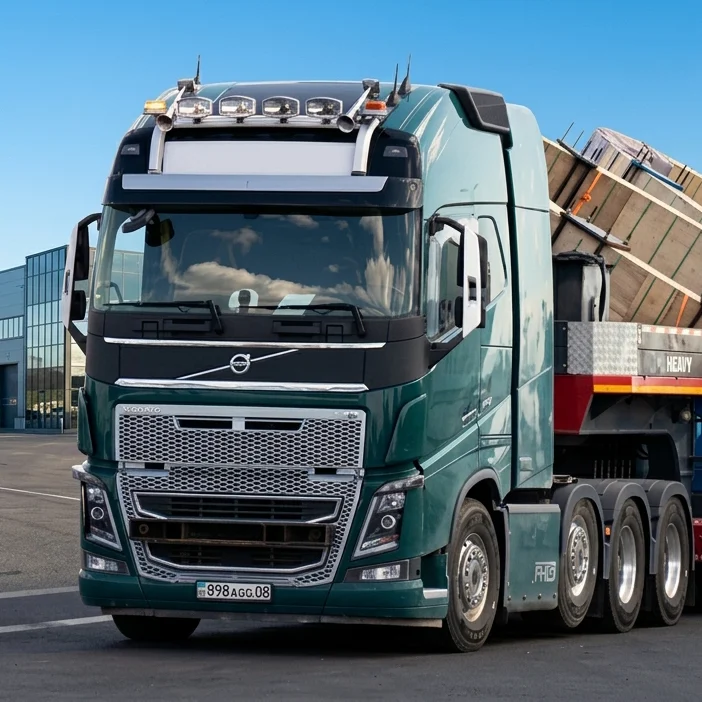
For reference. A machine 2.8 m wide already triggers a special permit and marking requirement. A 26 m steel structure on a road train exceeds the 24 m length limit — an oversize-by-length case requiring both a permit and route clearance.
A cross-border caveat. These thresholds apply within Kazakhstan only. Once a shipment crosses into Russia, Kyrgyzstan, Uzbekistan, China or the EU, the transit country's own limits take over — and they can diverge meaningfully on width, height and, in particular, road-train length. Our experience running Kazakhstan–Russia–China–Europe corridors is consistent: route engineering is always driven by the most restrictive parameter on the entire corridor, not the Kazakhstani baseline.
Permitting oversize cargo: the process
Moving oversize or overweight cargo on public roads without a special permit is prohibited and carries penalties under Kazakhstan's Administrative Offences Code.
The process, step by step
Establish the cargo's parameters. Measure the loaded vehicle's actual width, height, length and gross weight — this determines the degree of non-compliance and whether an escort will be required.
Select the vehicle configuration. A tractor, trailer or low-bed trailer, chosen against the load's height and weight profile. A low-bed platform is often the difference-maker on height compliance.
File through eGov.kz. OS/OW permits are issued via Kazakhstan's e-government portal, with the application submitted by the carrier or an authorized representative.
Secure route clearance. The relevant government authorities and road-network owners confirm the route is technically passable and that required safety measures are in place.
Settle the fee and receive the permit. A fee applies for exceeding weight or dimension limits, calculated against the degree of excess and the distance transported. Cross-border shipments additionally require a transit-country permit and customs clearance.
Additional cross-border requirements
— An international OS/OW permit issued separately in each transit country (Russia, Kyrgyzstan, Uzbekistan, China, etc.) — distinct from the Kazakhstani permit.
— A customs declaration and the full set of cargo-accompanying documents.
— Border-crossing clearance — for routes via Khorgos, Dostyk or other crossings, verify working hours and oversize-specific restrictions at the specific checkpoint well ahead of departure.
— Cargo insurance covering the entire route, transit countries included.
Securing and marking the load
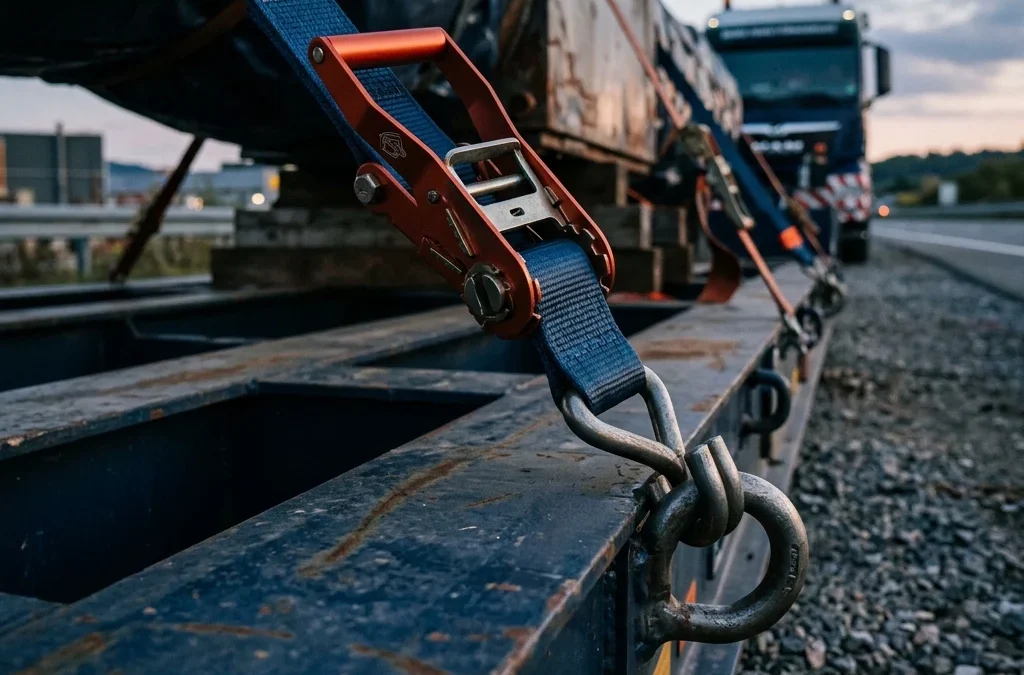
The load must be secured against shifting in transit and against extending any further beyond the permitted envelope. Standard securing methods include tie-down straps, dunnage or bracing (timber or steel — note that steel bracing adds to the road train's gross weight) and inflatable dunnage bags filling the void between the load and the body walls.
A vehicle carrying an overhanging load is marked with the "Oversize Cargo" sign — a board with alternating red-and-white reflective stripes, mounted on the outermost projecting edges of the load. After dark, supplementary lighting is required: white forward-facing, red rear-facing, amber to the side; the tractor and any escort vehicle carry an amber beacon.
From NG-NEGABARIT's field experience: delivering oversize steel structures to industrial sites, we redistribute the load across additional tie-down points on the trailer whenever the standard securing scheme can't hold long girders stable through tight turns — particularly on the mountainous stretches common to Central Asian corridors.
Escort requirements: the pilot vehicle
An escort becomes mandatory once the load's dimensions cross the thresholds set in the transport regulations — the exact threshold and escort configuration are fixed on the issued permit. The pilot vehicle is normally provided by the shipper or carrier; it runs ahead of or behind the convoy, alerts other road users, and assists through technically demanding stretches. Required equipment: an amber beacon, an information board, and reliable communication with the tractor driver.
For loads with a particularly wide margin of excess, a traffic-police patrol vehicle may also be assigned to the corridor — for tunnels, bridges, reversible-lane sections or major urban areas.
Penalties for non-compliant oversize transport
Kazakhstani penalties are denominated in MCI and scale with the degree of dimensional or weight non-compliance, as well as the offender's legal status. For 2026, 1 MCI = KZT 4,325.
Dimensional non-compliance
Party
MCI
KZT
USD*
Individual
20
86 500
≈ $188
Sole proprietor
30
129 750
≈ $282
Mid-size company
40
173 000
≈ $376
Large enterprise
50
216 250
≈ $470
Weight non-compliance
Excess
Party
MCI
KZT
USD*
1–5 t
Individual
40
173 000
≈ $376
Sole proprietor
80
346 000
≈ $752
Mid-size company
120
519 000
≈ $1 128
Large enterprise
200
865 000
≈ $1 880
5–10 t
Individual
80
346 000
≈ $752
Sole proprietor
130
562 250
≈ $1 222
Mid-size company
180
778 500
≈ $1 692
Large enterprise
280
1 211 000
≈ $2 633
Over 10 t
Individual
180
778 500
≈ $1 692
Sole proprietor
400
1 730 000
≈ $3 761
Mid-size company
700
3 027 500
≈ $6 582
Large enterprise
1000
4 325 000
≈ $9 402
*Calculated at an indicative rate of ≈KZT 460 to US$1 (National Bank of Kazakhstan, August–September 2026); confirm the prevailing rate at the time of payment.
On cross-border corridors, every transit country applies its own penalty schedule — compliance with Kazakhstani thresholds offers no protection against enforcement in Russia, China or the EU. Routing the shipment through a logistics partner familiar with each jurisdiction's permitting regime removes this exposure.
The true cost of a compliance failure
The fine is only one line item. Take a company transporting a 2.9 m-wide steel structure within Kazakhstan without a permit, flagged at a weight-and-dimension checkpoint. Beyond the fine to the legal entity (tens to hundreds of thousands of tenge), factor in: idle tractor and driver time, the cost of returning or storing the load, a delayed site-installation schedule, and after-the-fact permit issuance. On a cross-border corridor, add border detention time and a repeat customs clearance cycle. In practice, the total cost of a compliance failure typically runs 1.5–2x the fine itself.
Pricing oversize cargo transport
Price is a function of distance, cargo type and dimensional profile, the need for a low-bed trailer or escort, permit costs — and, on cross-border corridors, customs procedures and the number of transit countries.
Cost drivers:
— route length and the number of transshipments;
— vehicle configuration — standard flatbed, low-bed trailer, or heavy hauler;
— whether a pilot/escort vehicle is required;
— the number of transit countries and permits required in each;
NG-NEGABARIT's turnkey oversize cargo service covers route engineering across every transit country, vehicle selection, permitting in each jurisdiction, loading and load securing, escort, and customs clearance. Book well in advance — cross-border route clearance runs longer than domestic clearance, and compressed timelines tend to produce delays and fines rather than savings.
Next steps
If equipment or steel structures are headed to an industrial site, start with the load's actual dimensions and a preliminary route assessment against every transit country's regulations. For anything beyond a domestic move, route engineering, multi-jurisdiction permitting and end-to-end escort are best handed to a logistics partner who owns the full process.
NG-NEGABARIT arranges oversize and overweight cargo transport across Kazakhstan, Russia, Central Asia, China and Europe, with route engineering, permitting and escort managed at every leg. Contact us for a quote against your cargo specification.
Frequently Asked Questions
How long does route clearance take across multiple countries?
A route confined to Kazakhstan, with no complex approvals required, can be permitted within a few working days. A cross-border corridor — Kazakhstan–Russia–China, for instance — requires a separate permit in every transit country, and the full clearance cycle can extend to 2–3 weeks. Build in lead time accordingly, particularly where the route crosses multiple border checkpoints.
What happens if a height restriction surfaces on-route after the permit has already been issued?
The vehicle cannot proceed through that stretch — doing so risks damage to both infrastructure and cargo. Stop at a safe location and coordinate a route amendment with the authorizing body. An unauthorized detour outside the cleared route is treated as a permit violation, in Kazakhstan and in any transit country.
How far can cargo overhang the trailer or road-train profile?
Under Kazakhstani rules, the maximum overhang beyond the trailer or the highest point of the road train is 1 meter. The overhanging section must carry the "Oversize Cargo" marking, plus a light and reflector after dark.
How do Russian and Chinese requirements differ from Kazakhstan's on a cross-border route?
Each country maintains its own dimensional thresholds, permitting authority and penalty schedule. A configuration compliant in Kazakhstan — a 2.6 m-wide refrigerated body, for example — may already require a permit in another jurisdiction. Cross-border route planning means verifying thresholds against every transit country, not just the country of origin.
How is a dimensional or weight-limit fine appealed?
An appeal can be filed within the statutory window from the date of the ruling, either with the relevant transport control authority or through the courts. Supporting documentation should include the cargo's actual measured parameters, the valid permit, and the cleared route. Grounds for reversal vary — a measurement error, a divisible load shifting due to road conditions, or the vehicle having been leased to another carrier.
What distinguishes "oversize" from "overweight" cargo?
Oversize refers to non-compliance on width, height, length or overhang. Overweight refers to non-compliance on gross weight or axle load. A single consignment can be both at once — the combination determines which permit is required and which penalty schedule applies.